
Where to Find Better Travel Deals Than the Ones You See on Expedia
Frustrated by finding the same prices everywhere you look for hotels? You're not imagining it. Most travel booking sites are more connected than they appear, making traditional price shopping feel pointless.
This guide is for budget-conscious families, frequent travelers, and anyone tired of overpaying for accommodations while thinking they're getting the best deals available online.
Expedia travel deals and other major booking platforms operate within a complex system that keeps prices nearly identical across sites. We'll break down how travel booking sites make money behind the scenes and why wholesale travel platforms can offer genuine alternatives to the standard pricing you see everywhere else. You'll also learn why direct booking vs third party isn't the simple choice most people think it is, and discover the hidden costs behind travel rewards that credit card companies don't want you to notice.
How Travel Booking Sites Really Make Money Behind the Scenes
Understanding the 15-33% Commission Structure Hotels Pay to OTAs
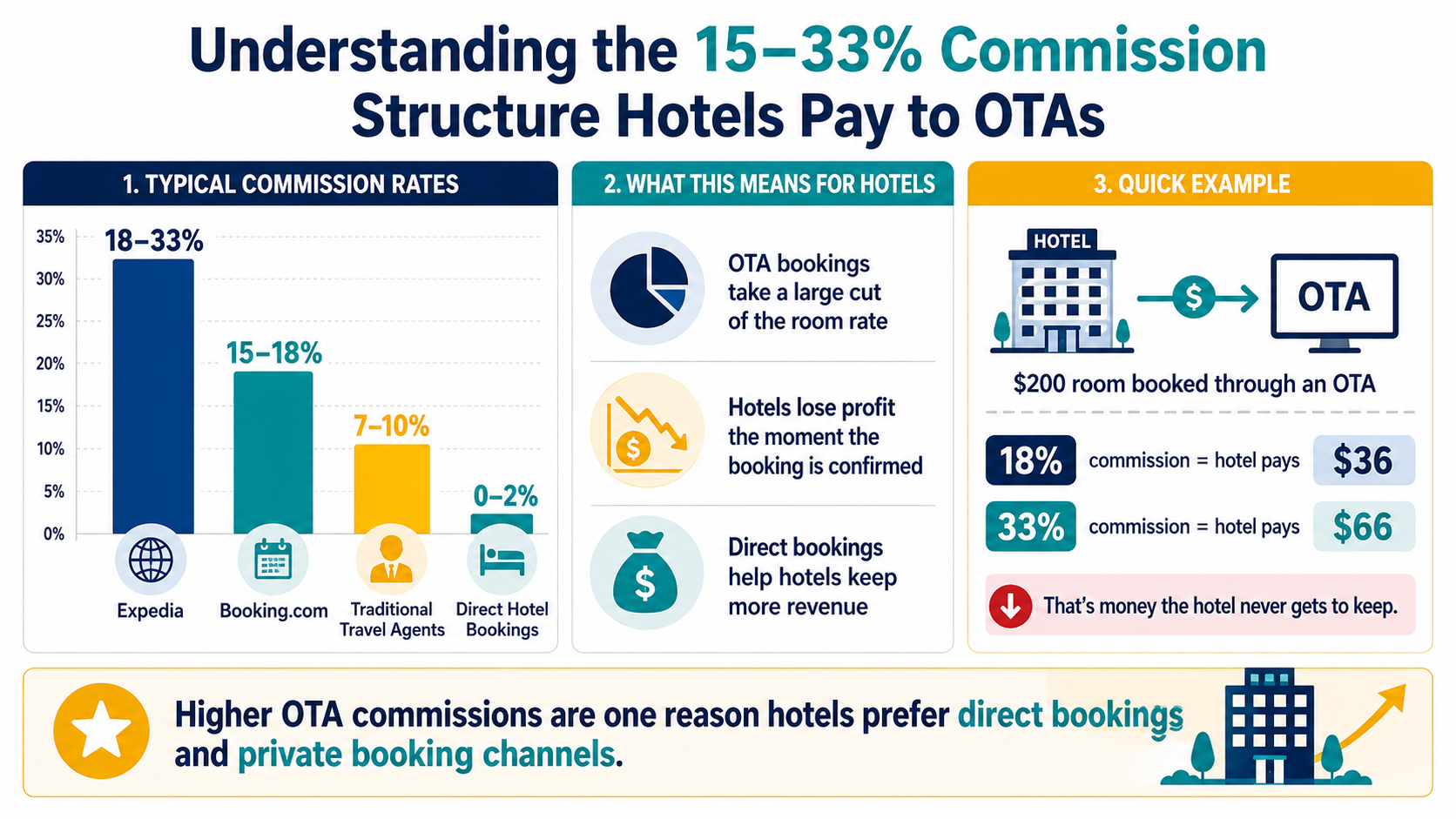
When you book through travel booking sites like Expedia, hotels face substantial commission costs that significantly impact their bottom line. Expedia charges between 18-33% of the room rate, while Booking.com typically charges 15-18%. To put this in perspective, traditional travel agents generally command much lower commissions around 7-10%, and direct hotel bookings may only incur 0-2% in processing fees.
This commission structure reveals a startling reality: when a guest books through an OTA, the hotel essentially refunds 10-20% of the room cost the moment the booking is confirmed. These substantial commission fees represent pure profit loss for hotels, as OTAs often provide minimal added value beyond basic booking facilitation. Third-party sites pay only a finder's fee of approximately 10% and often lack accountability for customer service issues, yet hotels must absorb these significant costs to maintain visibility on these platforms.
Why Rate Parity Requirements Force Hotels to Match Third-Party Prices
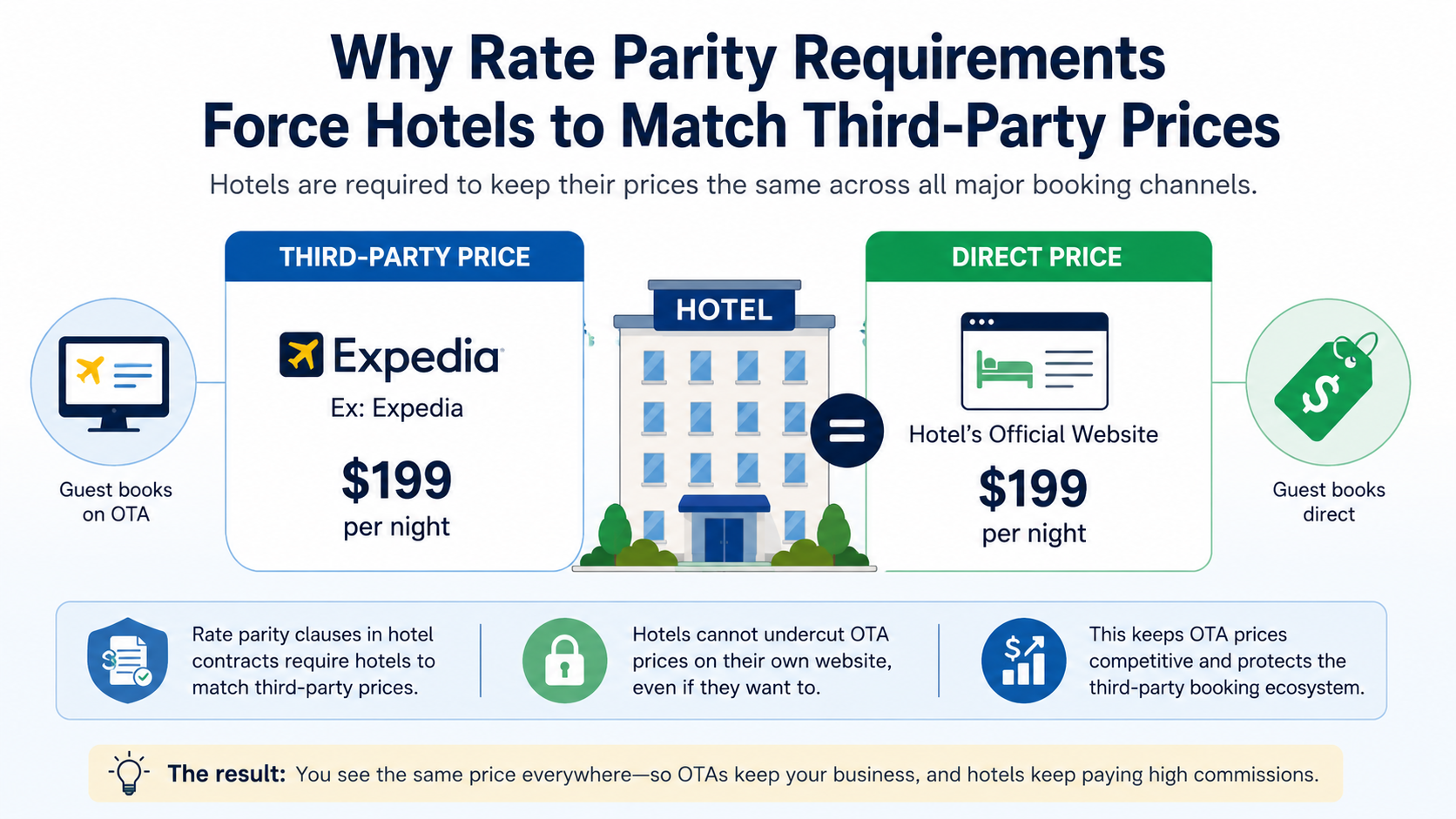
Rate parity requirements create a complex pricing dynamic that prevents hotels from offering significantly better travel deals on their direct booking channels. Franchisors mandate that rates displayed on the hotel's official website must either match the lowest available online rate or represent the lowest rack rate available across all platforms.
These rate parity issues essentially trap hotels in a pricing structure where they cannot undercut OTA pricing to incentivize direct bookings. Contractual obligations with franchisors and OTA platforms prevent this strategy, ensuring OTA pricing remains competitive while maintaining the third-party booking ecosystem. This explains why booking direct doesn't always save you money - hotels are contractually restricted from offering the discount travel deals they might prefer to provide.
How OTAs Manipulate Rates While Taking Significant Cuts
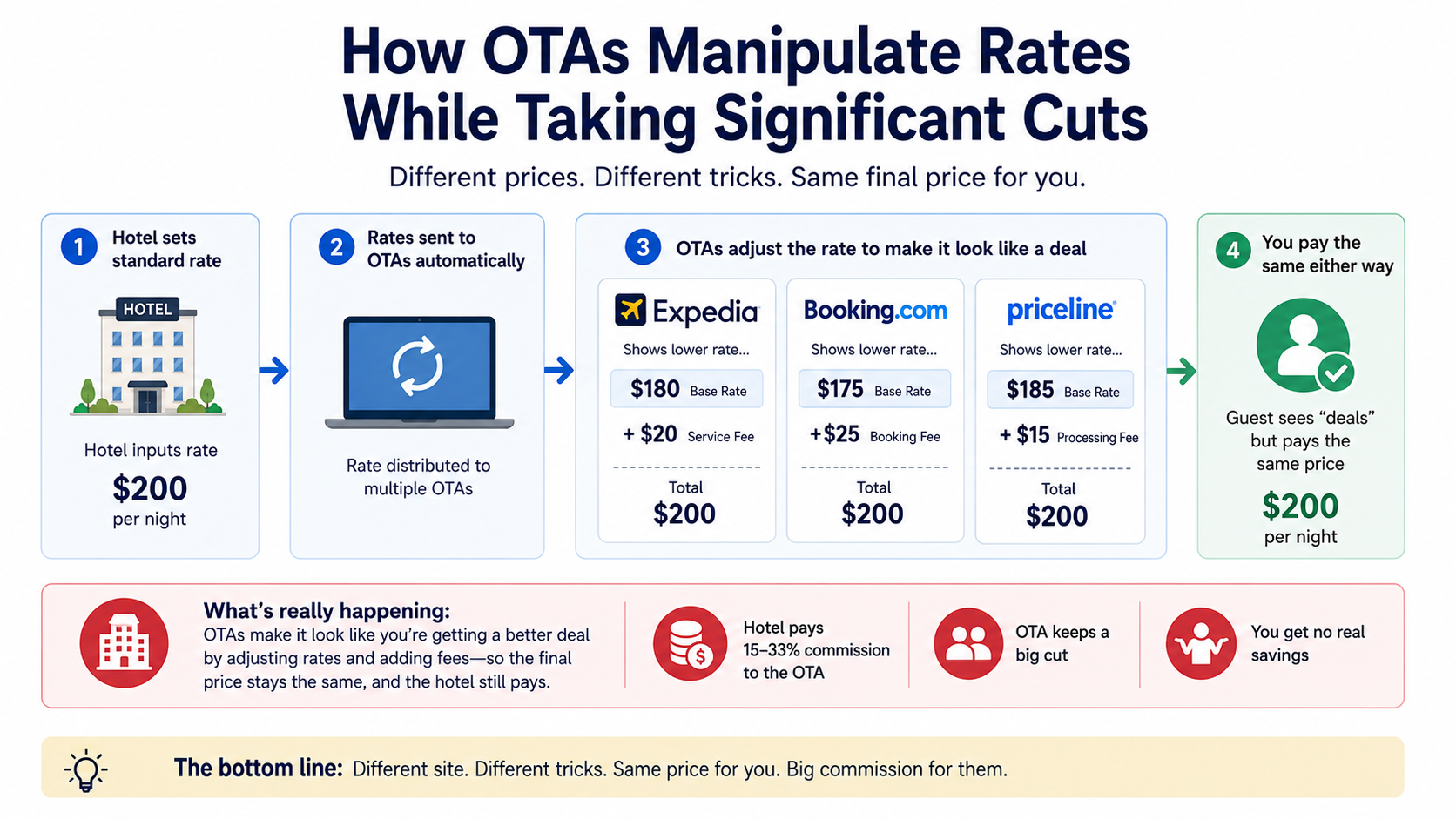
The rate manipulation process reveals how travel booking sites maintain pricing control while securing their commission structure. When hotels input rates into franchisor websites, the third-party website system automatically transmits these rates to various travel platforms. However, OTAs retain the ability to adjust these rates downward or add fees that result in the same total price for guests.
This manipulation strategy allows OTAs to appear competitive while maintaining their profit margins. Third-party websites may transmit lower base rates but compensate through additional fees, creating an illusion of savings while the final cost remains equivalent to direct booking prices. The guest experiences no actual savings, yet the OTA secures its substantial commission from the hotel. This practice explains why many travelers searching for cheap travel deals often find similar prices across platforms - the apparent competition is largely artificial, with hotels bearing the cost of these commission structures while guests see little real benefit.
Why All Travel Sites Show Nearly Identical Prices
The Travel Industry's Connected Distribution Networks
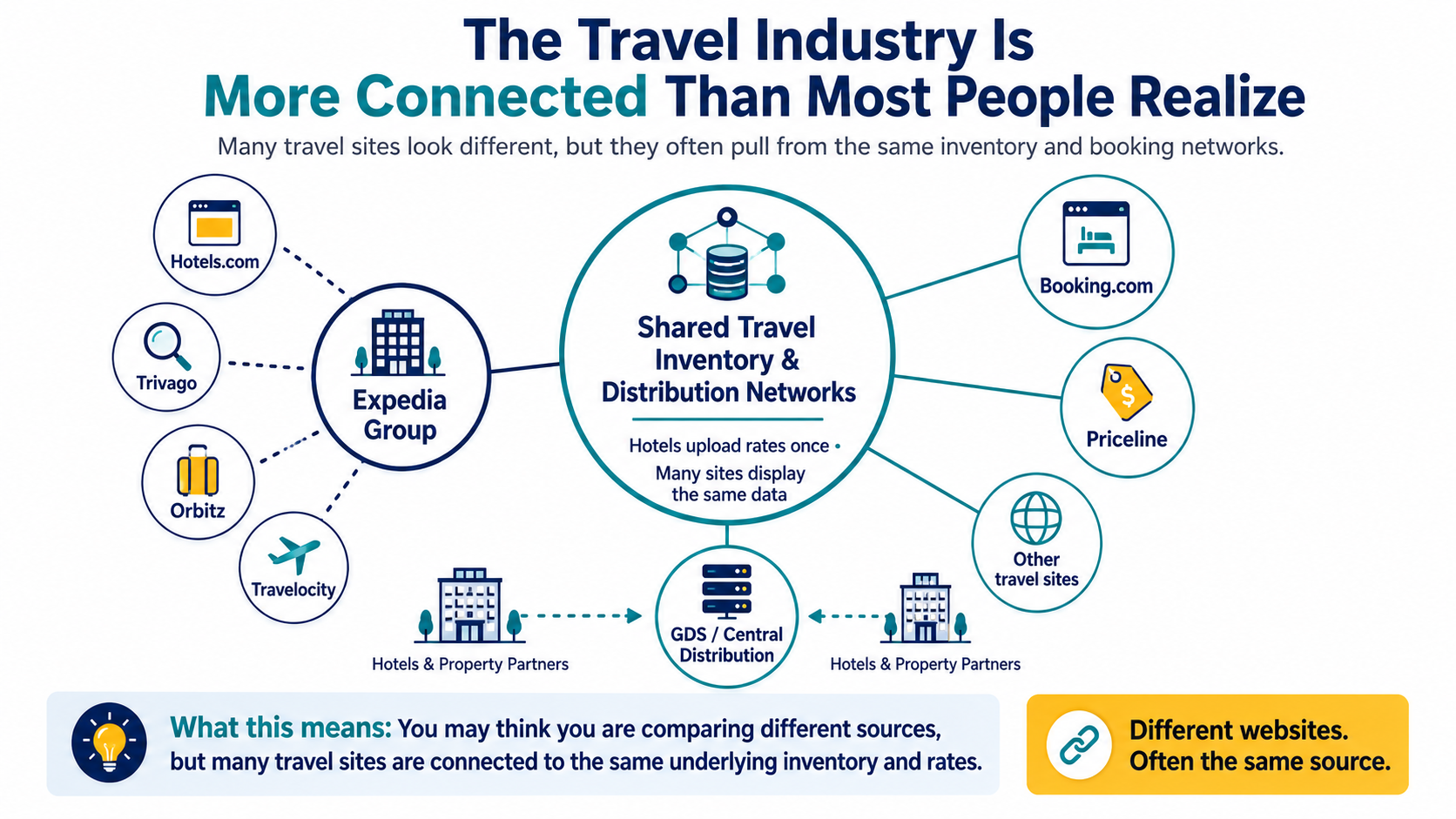
The illusion of choice when searching for travel deals becomes clear once you understand how the industry operates behind the scenes. Most major travel booking sites tap into the same massive distribution networks, creating what appears to be competition but is actually a synchronized system. Companies like Expedia Group demonstrate this perfectly - they own multiple brands including Hotels.com, Trivago, Orbitz, and Travelocity, all pulling from the identical inventory pool.
The hotel industry operates on a Global Distribution System (GDS), where properties upload their rates and availability to centralized platforms. These platforms then feed the same data to hundreds of travel booking sites simultaneously, meaning an "exclusive" deal found on different websites is likely the exact same rate agreement from the identical source. This interconnected web explains why your searches across multiple travel booking sites often yield remarkably similar results.
Comparison Sites Pull From the Same Sources
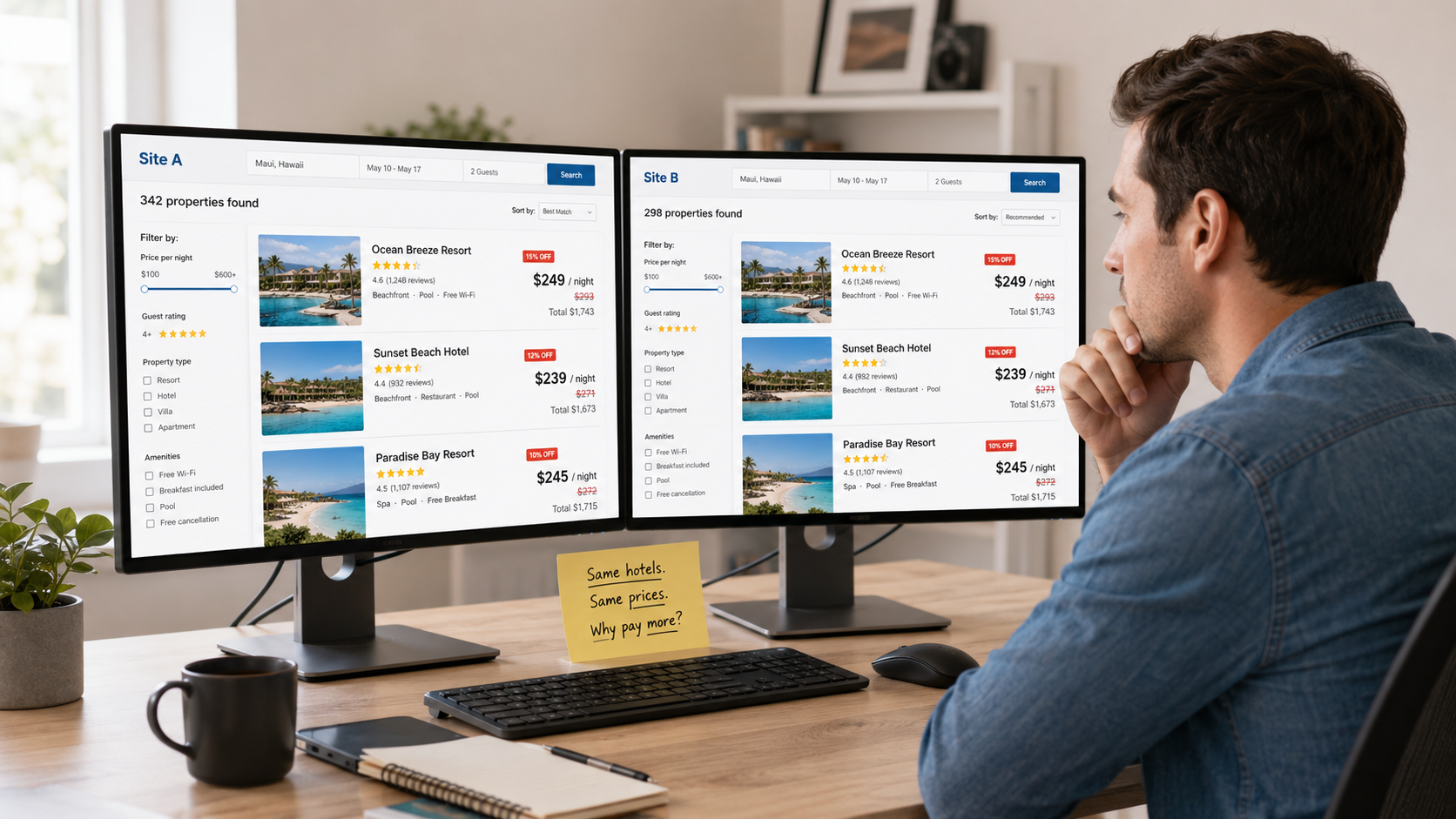
Popular comparison websites like Kayak, Trivago, or Google Travel create a false sense of comprehensive price shopping. While these platforms appear to pull data from multiple sources, many are interconnected or owned by the same parent companies. The Expedia pricing strategy has been particularly effective at creating this illusion of choice across the market.
Travel booking sites also employ sophisticated algorithms that track user behavior and location data, personalizing prices based on your search patterns. This means two people searching for the same hotel might see different rates, but the underlying rate structures remain consistent across platforms. The commission structure between hotels and OTA pricing models creates inherent uniformity, making dramatic price differences rare among mainstream sites when comparing true baseline rates.
Rate Parity Agreements Create Artificial Price Floors
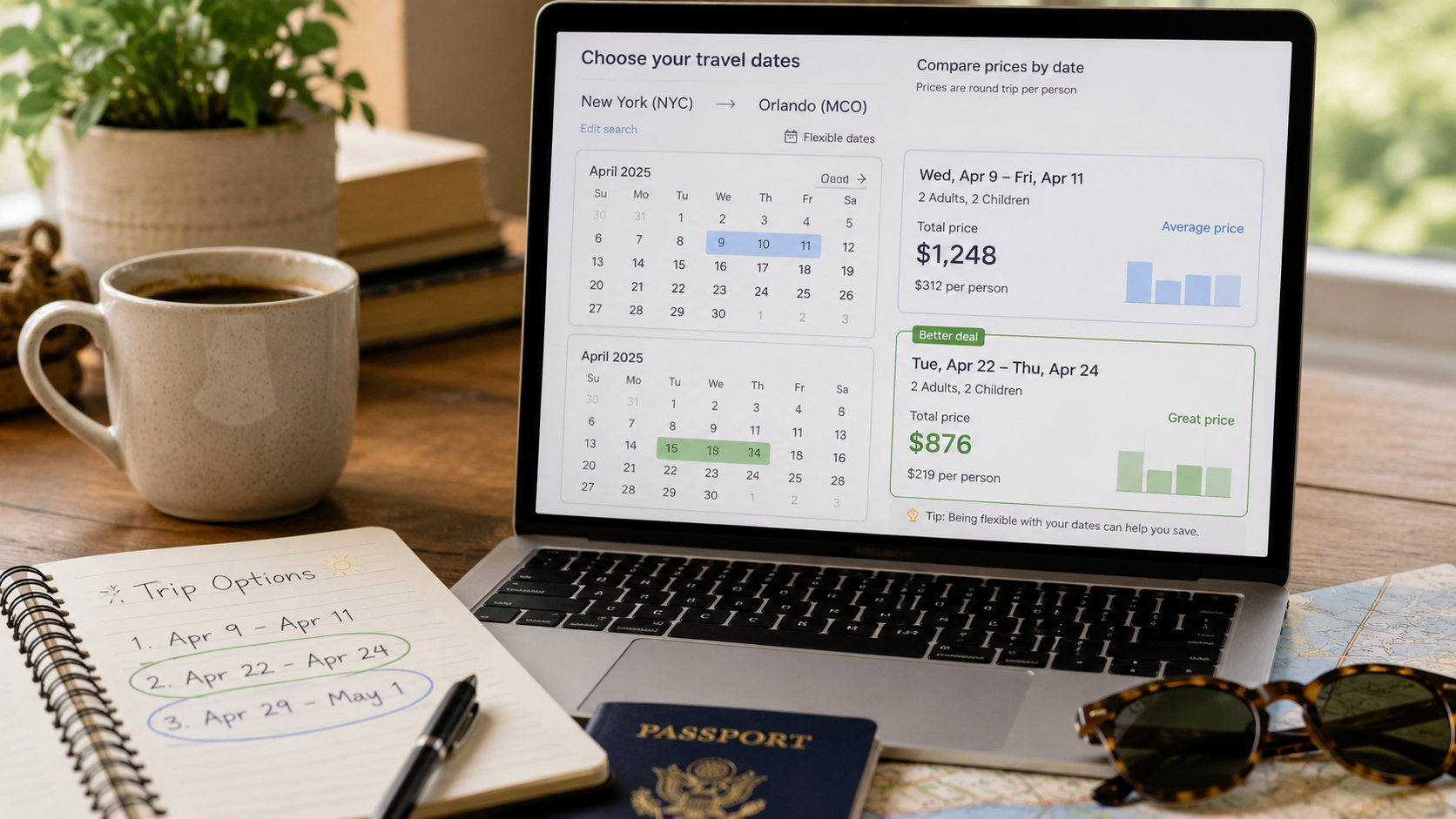
Traditional price shopping advice falls short in the travel industry due to these interconnected systems - checking multiple OTAs often yields nearly identical prices by design, not by coincidence. Hotels implement rate parity clauses in their distribution agreements, requiring booking platforms to match or stay within a narrow range of their direct booking prices.
These agreements prevent OTAs from undercutting each other significantly, creating an artificial price floor across the market that benefits hotels while limiting genuine competition. The few price variations you do encounter usually come from differences in bundled services, loyalty point values, or temporary promotional credits, not actual room rate differences. Some sites might offer free breakfast or Wi-Fi, or site-specific rewards programs to create perceived value without changing the base price, maintaining the illusion of competitive pricing while adhering to rate parity requirements.
How Wholesale Travel Platforms Break the Traditional Pricing Model
Accessing Private Pricing Channels Not Available to Public OTAs

While most travelers are familiar with public booking sites like Expedia and other major online travel agencies, they're only seeing one slice of the travel pricing ecosystem. Hotels and resorts maintain multiple pricing channels for different types of buyers, including travel agents, wholesale partners, private groups, and member-based platforms. These private pricing channels operate completely separate from the public OTA model that most consumers encounter.
Wholesale travel platforms like Family for Adventure break this traditional mold by providing access to these exclusive pricing tiers that aren't available through conventional discount travel websites. Unlike public OTAs that only display standard consumer rates, these platforms tap into the private side of travel pricing, revealing rates that would otherwise remain hidden from typical travelers searching for cheap travel deals.
Cutting Out Middlemen to Reduce Unnecessary Markups
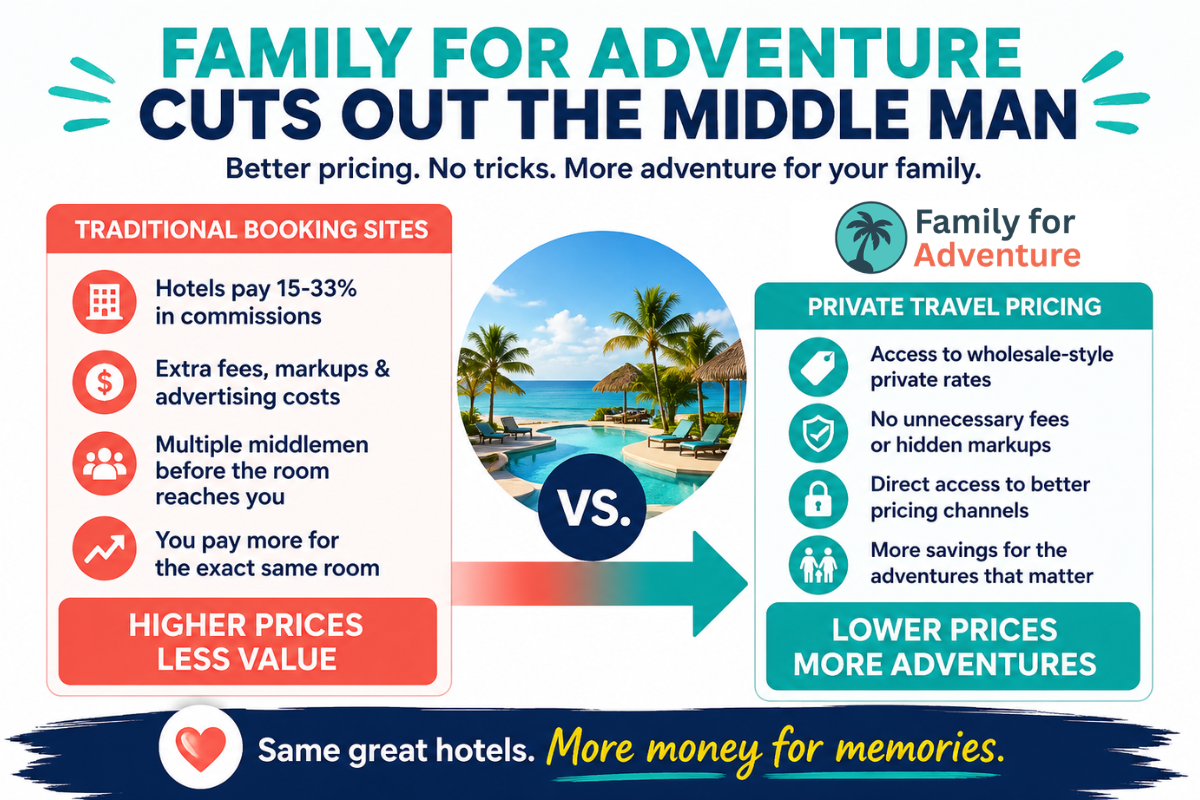
Now that we understand the existence of private pricing channels, it's important to recognize how commission-based systems inflate travel costs. The prices displayed on major online travel agencies typically include multiple layers of markup: commissions for the booking platform, advertising costs, and fees for various middlemen in the distribution chain.
Wholesale travel platforms fundamentally restructure this pricing model by eliminating these unnecessary layers. Rather than building in room for commissions and platform markups that benefit booking intermediaries, these platforms provide direct access to wholesale-style pricing. This approach represents a significant departure from the standard travel booking sites comparison model, where travelers are essentially paying for the convenience and marketing costs of major booking platforms.
Getting Real Wholesale Rates Instead of Commission-Based Pricing
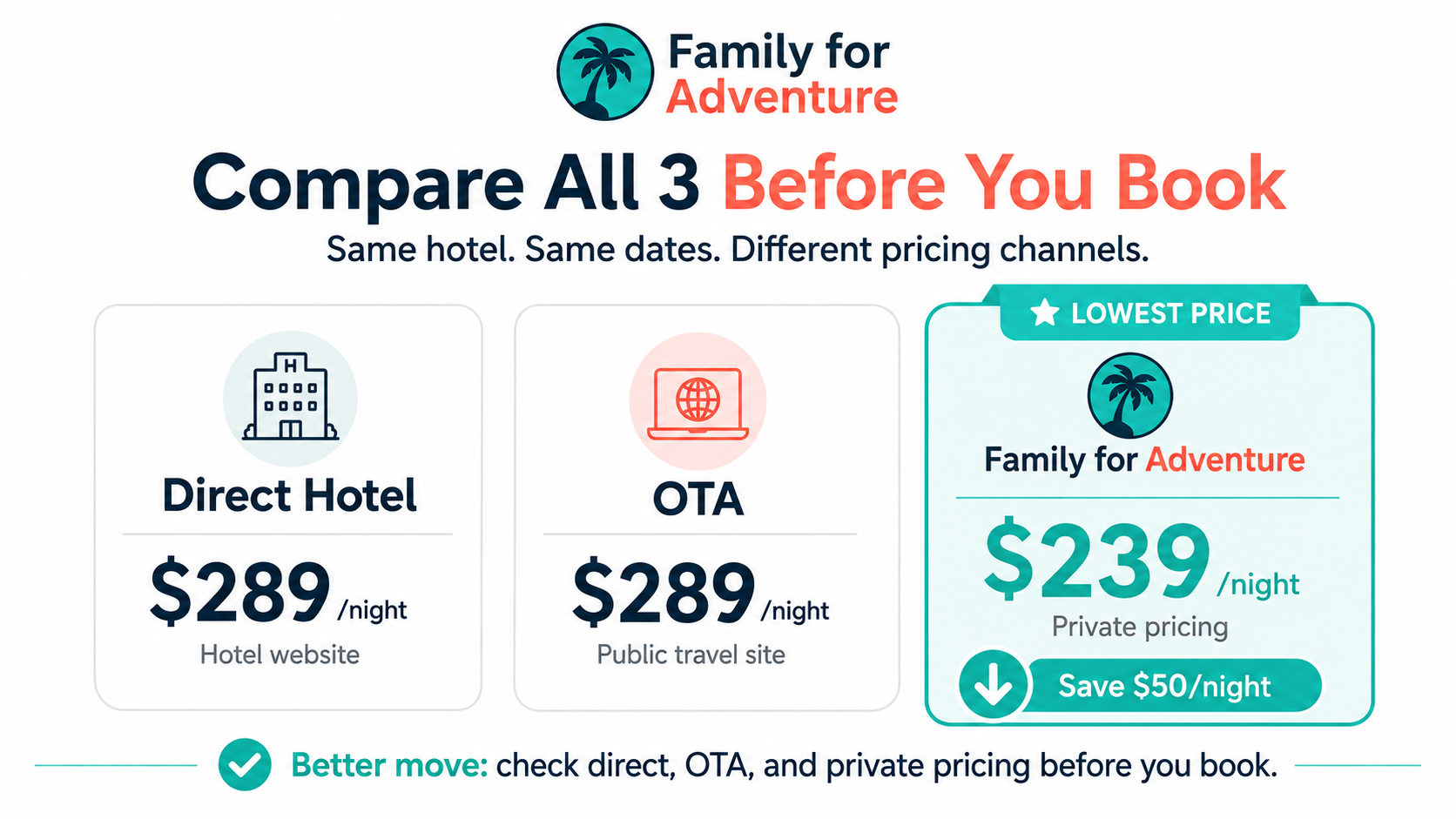
With this understanding of how markups accumulate, wholesale platforms offer access to true private pricing rather than commission-inflated rates. This pricing structure means travelers aren't dependent on complex point systems, last-minute flash sales, or confusing reward programs to access better than Expedia deals.
The wholesale approach focuses on providing straightforward access to superior pricing channels for hotels, resorts, and travel accommodations. By securing genuine wholesale rates, travelers can achieve substantial savings on one of the most expensive components of their trips, making travel more accessible and affordable without the complexity of traditional reward-based systems. 👉 Try wholesale prices for yourself and see how much you could save.
Why Booking Direct Doesn't Always Save You Money
Price Parity Agreements Limit Hotel's Ability to Offer Lower Rates

Many travelers assume that booking directly with hotels guarantees the lowest rates, but this common misconception overlooks the complex contractual relationships that govern travel booking sites comparison. Hotels participate in rate parity agreements that create significant restrictions on their pricing flexibility. These agreements prevent hotels from substantially undercutting their distribution partners, establishing an artificial price ceiling across booking platforms.
The reality is that hotels cannot offer significantly lower prices on their own websites without violating their agreements with OTA partners. This means that when you visit a hotel's direct website expecting better than Expedia deals, you're often encountering the same rates you'd find on major booking platforms. The Expedia pricing strategy and similar approaches from other OTAs rely heavily on these agreements to maintain their commission-based business model, ensuring they remain competitive while protecting their revenue streams.
Direct Booking Benefits Don't Always Equal Cash Savings

While hotels often promote direct booking advantages, these benefits don't necessarily translate to actual monetary savings. Properties typically offer perks like complimentary breakfast, room upgrades, or loyalty points for direct reservations, but these incentives may not provide tangible financial value for all travelers.
Price differences between direct booking vs third party platforms are frequently minimal or completely nonexistent. In some cases, OTAs actually deliver superior cheap travel deals through flash sales or package bundles that hotels cannot legally match due to their contractual obligations. Major booking platforms often negotiate exclusive promotional rates or create package combinations that provide better overall value than what's available through direct channels.
Direct booking does offer distinct advantages beyond pricing considerations, including superior customer service, more flexible cancellation policies, and the ability to make specific room preference requests. However, assuming the hotel's website will consistently provide the lowest rate represents a flawed strategy if cost minimization remains your primary objective.
Smart Comparison Includes Direct, OTA, and Private Pricing Options
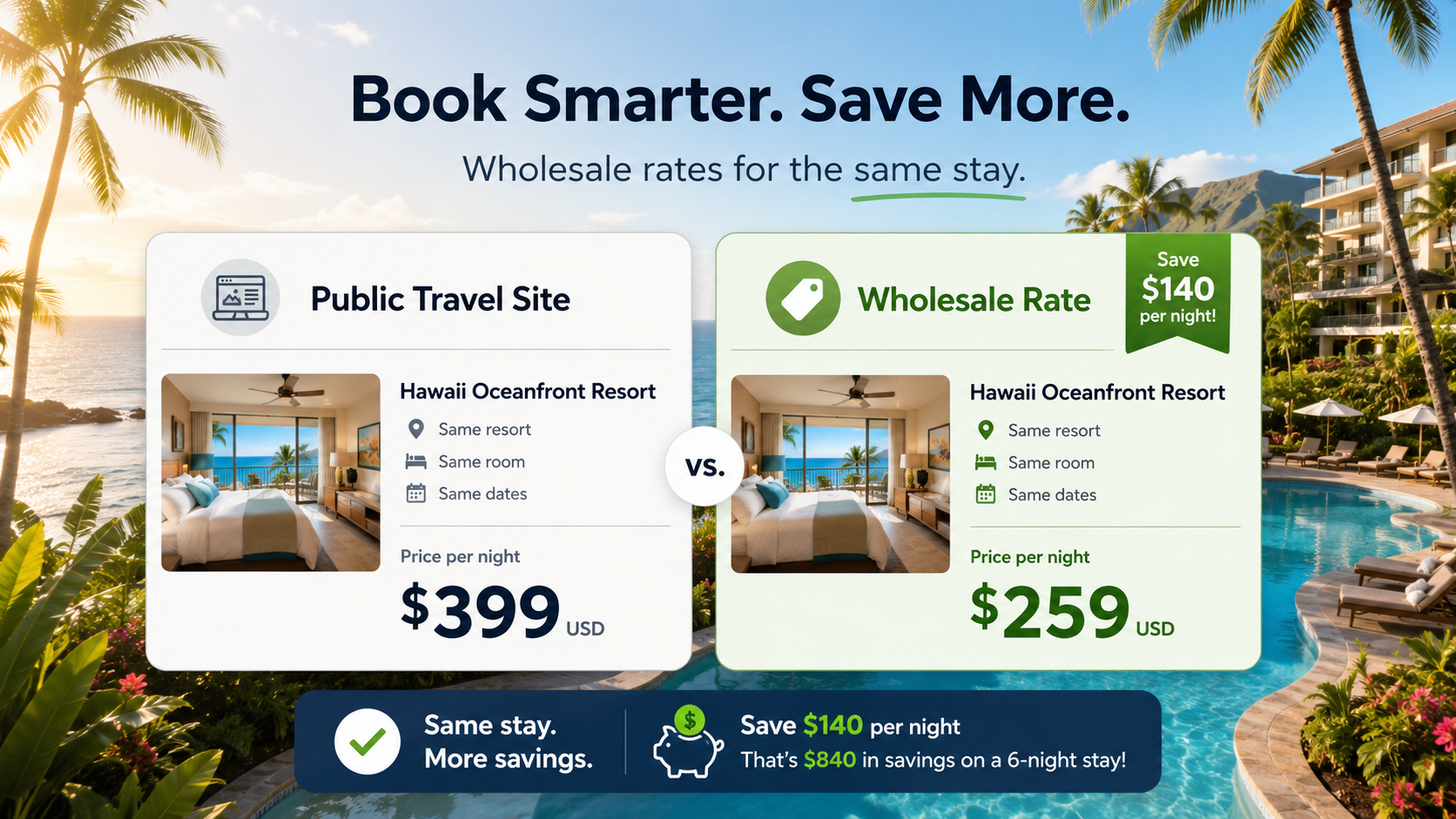
Effective budget travel booking tips require a comprehensive comparison approach across multiple booking channels. Start by examining the hotel's direct website to understand baseline rates and available perks, then systematically check major OTAs for promotional rates or package deals that might exceed the direct booking value proposition.
The most significant opportunity lies in wholesale travel platforms that operate outside traditional price parity agreements. These specialized booking systems often maintain access to contracted rates unavailable to general consumers, potentially offering discount travel websites with substantially better pricing than conventional channels.
When conducting your travel deal finder research, consider the total cost rather than focusing exclusively on room rates. A slightly higher direct booking price might include valuable benefits like complimentary parking or breakfast that would incur additional charges through other booking methods, ultimately providing superior overall value despite the higher base rate.
The Hidden Costs of Credit Card Points and Travel Rewards
Points Require Significant Spending to Earn Meaningful Redemptions

Every point earned through travel rewards programs represents actual spending on a credit card, and the mathematics reveal a sobering reality about their true cost. To accumulate enough points for meaningful travel redemptions, travelers typically need to spend thousands of dollars through their credit cards. Most travel credit cards require between 50,000 to 100,000 points for a decent hotel stay or flight, while earning rates usually hover around 1-2 points per dollar spent.
This means travelers must spend $25,000 to $100,000 to earn a "free" vacation worth only $500 to $1,500. When you consider that spending $50,000 to earn points for a $1,000 vacation, those points are clearly not truly free. The opportunity cost of this spending, combined with the extended time required to accumulate meaningful point balances, makes this strategy far less attractive than finding better cash deals through wholesale travel platforms or discount travel websites.
Point Values Distract From Actual Cash Prices and Better Deals

The psychology of points creates a dangerous blind spot in travel planning that prevents travelers from finding legitimate discount travel deals. The human brain doesn't automatically translate a hotel room priced at 40,000 points to its cash equivalent, leading to consistently poor financial decisions. Many travelers become obsessed with "maximizing point value" and lose sight of whether they're actually getting a good deal compared to what's available on travel booking sites.
This psychological trap often leads travelers to view a 60,000-point hotel as a bargain compared to an 80,000-point option, even when both represent overpriced accommodations in cash terms. The same hotel room might cost $200 when booked through Expedia travel deals or other budget travel booking platforms, while the points redemption represents $300 worth of actual spending. This distorted perception prevents travelers from discovering better than Expedia deals available through direct comparison shopping and wholesale travel platforms.
Credit Card Debt Risks Outweigh Point Benefits for Many Travelers
The pursuit of travel rewards hidden costs extends far beyond point accumulation, contributing to a broader financial crisis affecting millions of travelers. Federal Reserve data reveals credit card debt has reached record highs, with the average household carrying over $6,000 in credit card debt. Travel enthusiasts often justify additional spending specifically to earn points, creating a dangerous cycle where vacation dreams fuel ongoing debt accumulation.
High interest rates on credit cards, typically 20% or higher, quickly erode any perceived value from point earnings. Consider this example: spending an extra $5,000 to earn a 60,000-point signup bonus worth approximately $600 could cost over $1,100 in interest charges over a year if not paid off immediately. This means the "free" vacation actually costs $500 in interest alone, making it far more expensive than simply booking through discount travel websites or finding cheap travel deals through direct comparison shopping.
Instead of chasing travel rewards that mask their true costs, savvy travelers focus on finding legitimate budget travel booking opportunities through wholesale platforms and direct booking strategies that deliver immediate savings without the debt risks.
Ready To Save On Your Next Vacation?
The travel booking world is more complicated than most people realize. The big online travel sites make it feel like you are comparing all your options, but in many cases, you are only comparing different versions of the same public pricing system. Expedia, Orbitz, Priceline, Travelocity, and other major OTAs can be useful tools, but they are not always built to show you the lowest available travel price. Direct booking does not automatically mean you are getting a better deal either. And while credit card points can have value, they often come with restrictions, limited availability, annual fees, blackout dates, or complicated redemption rules that make the savings less powerful than they seem.
The better approach is to stop booking based on habit and start booking based on access. If you only search public travel sites, you are usually only seeing public travel prices. But when you understand how hotel pricing really works, you can start looking beyond the big public booking sites and compare options that may give you access to private rates, wholesale-style pricing, and deals that are not always shown on the major OTAs.
That is exactly why we created Family for Adventure. We wanted to give families a simple way to compare better hotel and resort deals without having to spend hours searching every travel site or waiting for a once-a-year sale. Instead of automatically booking through the same public sites, you can check Family for Adventure, compare the savings, and see if there is a better deal available for your next trip.
Because the goal is not just to book a cheaper room. The goal is to make travel feel possible again, save money on one of the biggest parts of the trip, and use those savings for the experiences your family will actually remember.
So before you book your next hotel, try Family for Adventure and see if you can find a better deal for your next getaway.