
Where to Get Better Hotel Deals Than the Ones You Find on Expedia
Planning your next vacation but confused about why Expedia hotel deals and other travel booking sites all show similar prices? You're not alone. This guide breaks down the complex world of OTA pricing and reveals how travel booking sites really make money—and how you can save more on your trips.
This information is for budget-conscious travelers, families planning vacations, and anyone who wants to understand why booking direct vs OTA isn't always the obvious choice it seems to be.
We'll explore how Expedia pricing strategy and price parity travel rules keep rates nearly identical across platforms, examine where wholesale travel booking sites like Family for Adventure fit into this landscape, and explain why your credit card travel points might not deliver the savings you expect. You'll also discover why the "always book direct" advice doesn't tell the whole story about getting the best deals.
How OTA Pricing and Commissions Really Work Behind the Scenes
Understanding the 15-33% Commission Structure Hotels Pay to OTAs
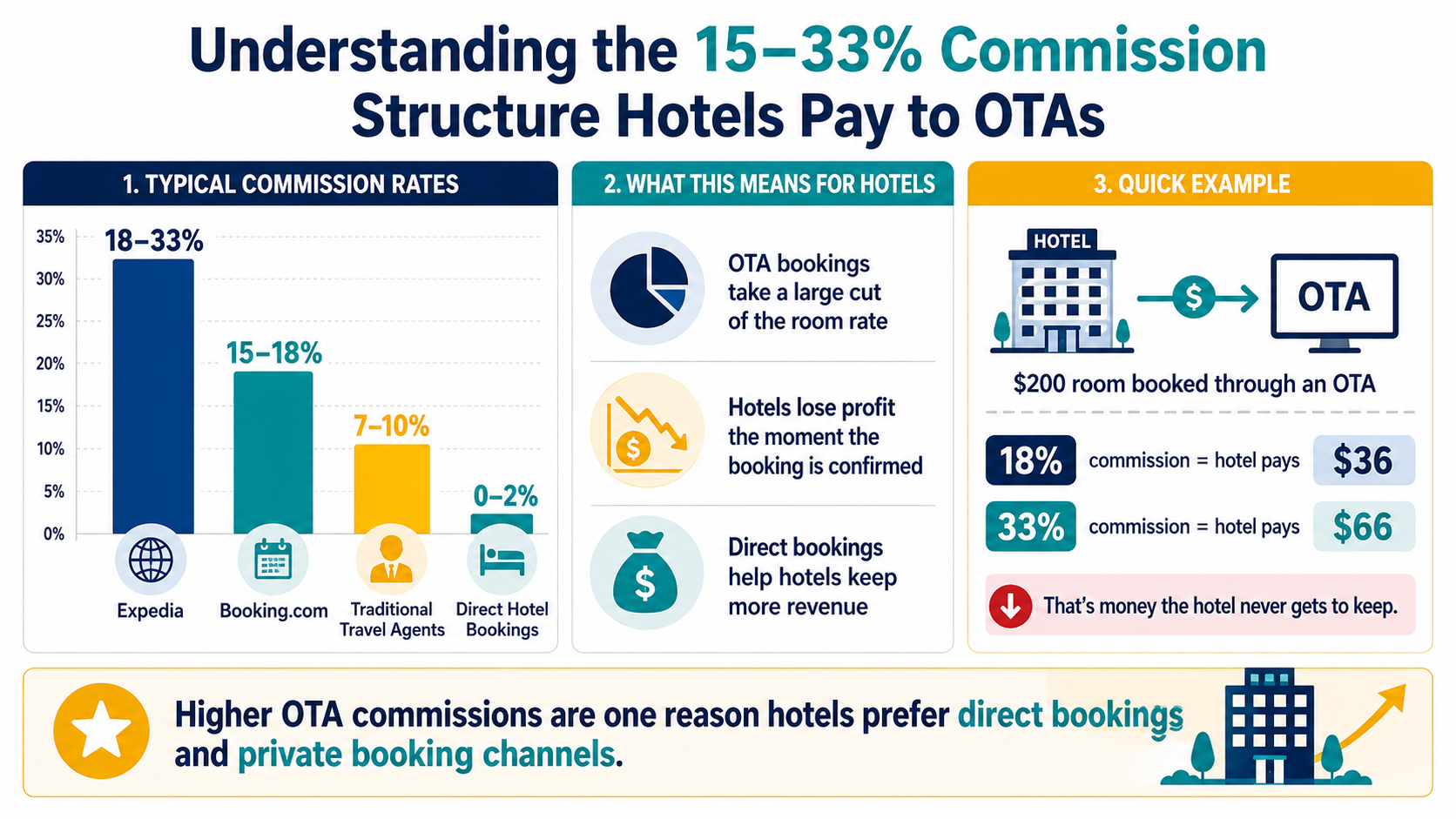
When you book through Expedia hotel deals or other travel booking sites, hotels face significant commission costs that directly impact their profitability. The commission structure varies considerably across platforms, with Expedia charging between 18-33% of the room rate, while Booking.com typically charges 15-18%. Traditional travel agents generally command lower commissions around 7-10%, and direct hotel bookings may only incur 0-2% in processing fees.
This dramatic difference in commission rates explains why hotels consistently prefer direct bookings over third-party reservations. When a guest books through an OTA, the hotel essentially refunds 10-20% of the room cost the moment the booking is confirmed. These substantial commission fees represent pure profit loss for hotels, as OTAs often provide minimal added value beyond basic booking facilitation.
The impact becomes even more pronounced when considering that third-party sites pay only a finder's fee of approximately 10% and often lack accountability for customer service issues that arise during the stay. Hotels must absorb these costs while still maintaining competitive pricing in the marketplace.
Why Rate Parity Requirements Force Hotels to Match Third-Party Prices
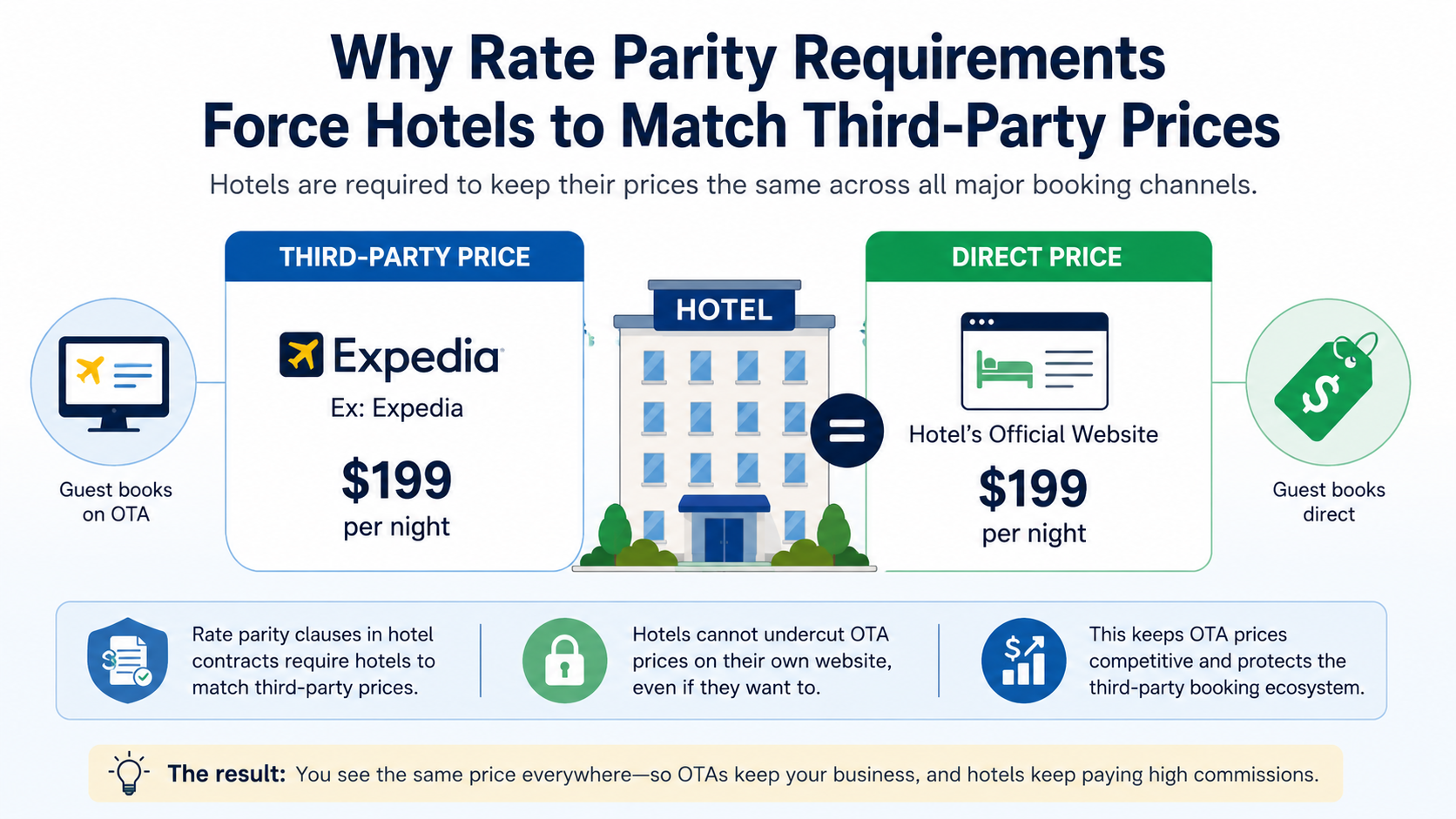
Rate parity requirements create a complex pricing dynamic that prevents hotels from offering significantly lower rates on their direct booking channels. Franchisors mandate that rates displayed on the hotel's official website must either match the lowest available online rate or represent the lowest rack rate available across all platforms.
These rate parity issues essentially trap hotels in a pricing structure where they cannot undercut OTA pricing to incentivize direct bookings. Even when hotels would prefer to offer lower rates through their own channels to avoid commission fees, contractual obligations with franchisors and OTA platforms prevent this strategy.
This regulatory framework ensures that OTA pricing remains competitive while maintaining the third-party booking ecosystem that generates substantial revenue for travel booking sites.
How OTAs Manipulate Rates While Taking Significant Cuts
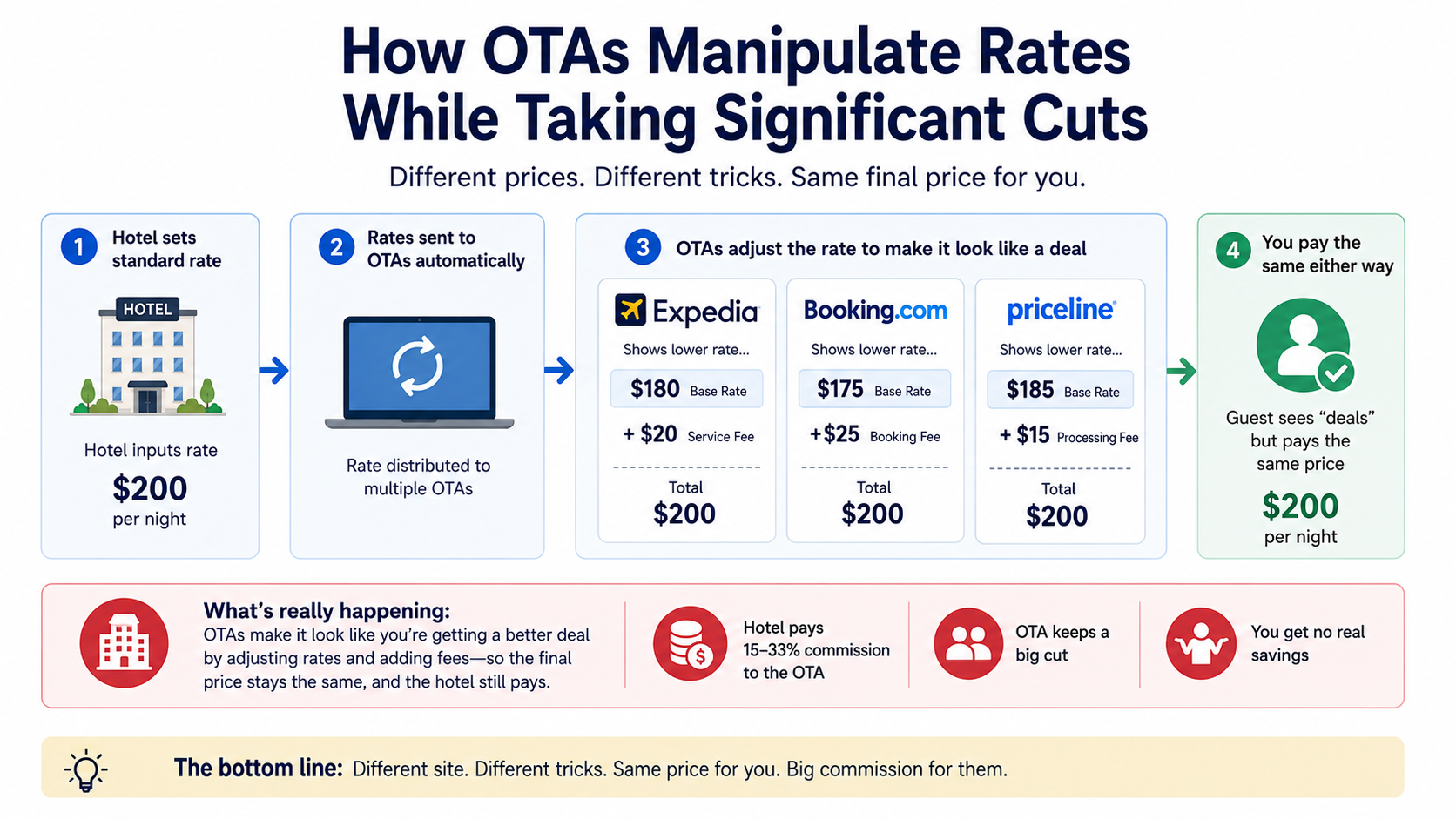
The rate manipulation process reveals how OTAs maintain pricing control while securing their commission structure. When hotels input rates into franchisor websites, the third-party website system automatically transmits these rates to various travel platforms. However, OTAs retain the ability to adjust these rates downward or add fees that result in the same total price for guests.
This manipulation strategy allows OTAs to appear competitive while maintaining their profit margins. Third-party websites may transmit lower base rates but compensate through additional fees, creating an illusion of savings while the final cost remains equivalent to direct booking prices. The guest experiences no actual savings, yet the OTA secures its substantial commission from the hotel.
This system demonstrates how travel booking sites extract value from the transaction without providing corresponding benefits to either hotels or travelers, highlighting the importance of understanding these behind-the-scenes mechanisms when making booking decisions.
Orlando Savings Spotlight
Family Resort / 2 Queen Room / 4 Nights
Public OTA Price: $1,456 | Family for Adventure Price: $1,088
Total Savings : $368
Why So Many Travel Sites Show Similar Prices
The travel industry is more connected than most people realize
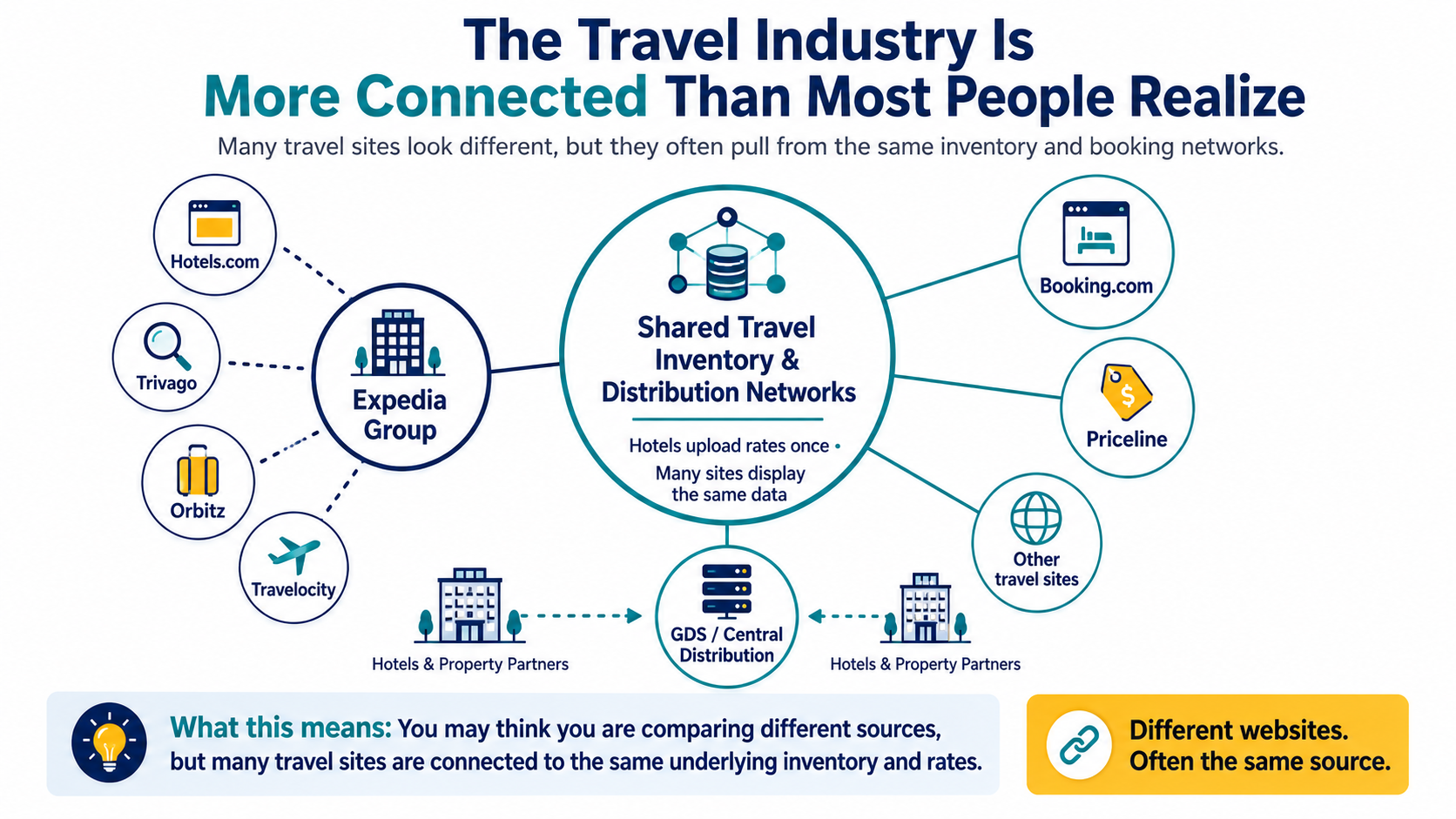
When you search for hotels on different travel sites, you're not actually seeing quotes from dozens of independent suppliers. The reality is that most major travel booking sites tap into the same massive distribution networks. Companies like Expedia Group actually own multiple brands - Hotels.com, Trivago, Orbitz, Travelocity, and others all pull from the same inventory pool. This means when you think you're comparing different sources, you're often just seeing different faces of the same booking engine.
The hotel industry operates on what's called a Global Distribution System (GDS), where properties upload their rates and availability to centralized platforms. These platforms then feed the same data to hundreds of travel booking sites simultaneously. So that "exclusive" deal you found on three different websites? It's probably the exact same rate agreement coming from the identical source, just packaged with different marketing language.
Comparison sites are not always comparing different sources
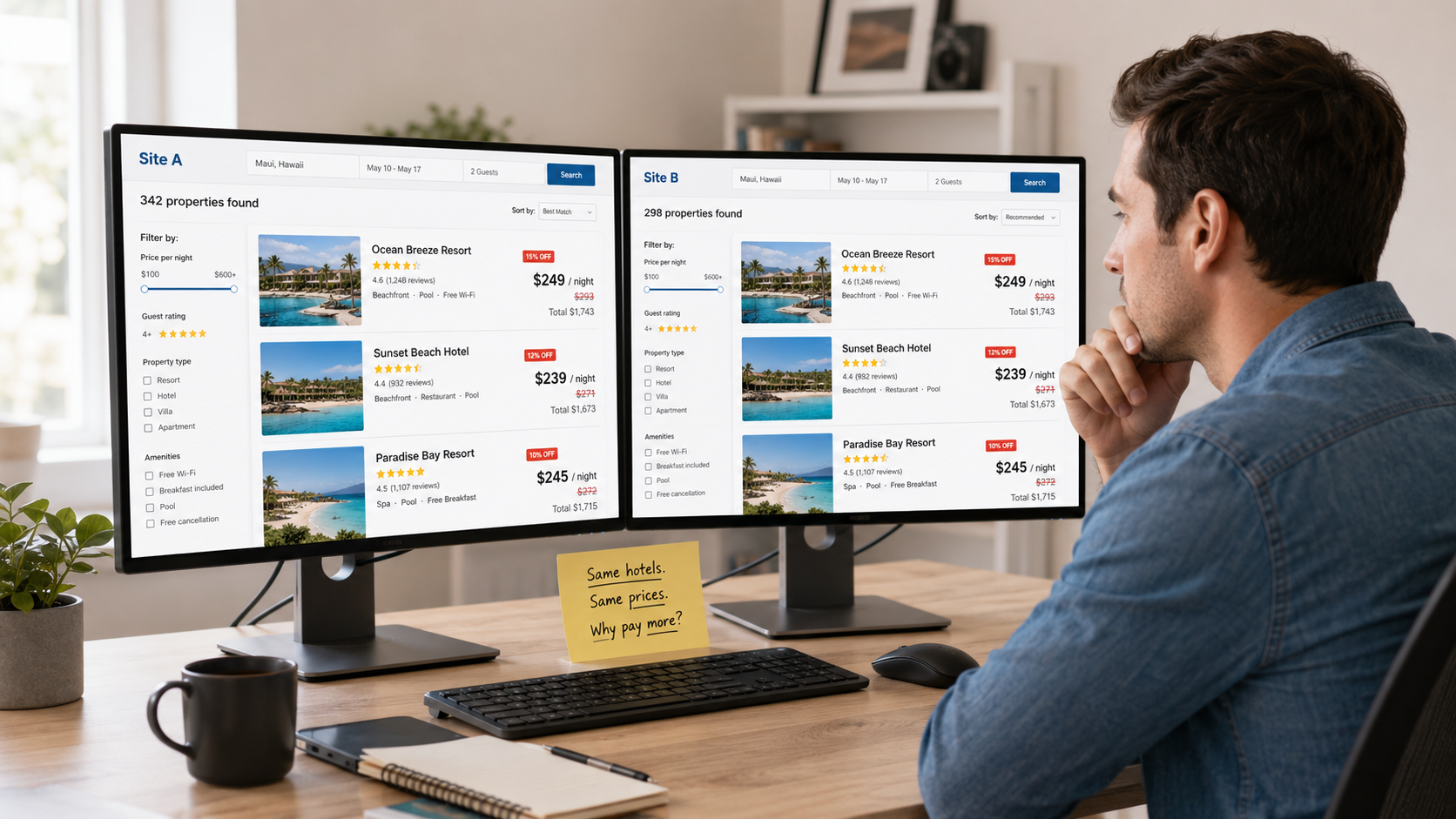
Popular comparison websites like Kayak, Trivago, or Google Travel give travelers a false sense of comprehensive price shopping. While these platforms do pull data from multiple sources, many of those sources are interconnected or owned by the same parent companies. The Expedia pricing strategy has been particularly effective at creating this illusion of choice while maintaining control over distribution channels.
Travel booking sites also use sophisticated algorithms that track user behavior and location data. This means the prices you see might be personalized based on your browsing history, device type, or geographic location. Two people searching for the same hotel on the same day might see different rates, even when using identical comparison tools.
The commission structure between hotels and OTA pricing models creates another layer of uniformity. Hotels typically offer the same commission rates to major distributors, which translates to similar markups across platforms. This standardization makes dramatic price differences rare among mainstream travel booking sites.
That's why "shopping around" can feel like seeing the same price everywhere

Traditional price shopping advice falls short in the travel industry because of these interconnected systems. You might spend hours checking Expedia hotel deals, then Booking.com, then Hotels.com, only to find nearly identical prices. This isn't coincidence - it's by design.
Hotels also implement rate parity clauses in their distribution agreements, requiring booking platforms to match or stay within a narrow range of their direct booking prices. These agreements prevent OTAs from undercutting each other significantly, creating an artificial price floor across the market.
The few price variations you do see usually come from differences in bundled services, loyalty point values, or temporary promotional credits rather than actual room rate differences. Some sites might throw in free breakfast or Wi-Fi to create perceived value without changing the base price. Others might offer site-specific rewards programs or cashback percentages that marginally adjust your total cost.
This system explains why finding genuinely different pricing requires looking beyond the traditional OTA ecosystem into wholesale travel booking platforms or specialty providers that operate outside these standard distribution agreements.
Where Family for Adventure Fits In
Family for Adventure cuts out the middle man
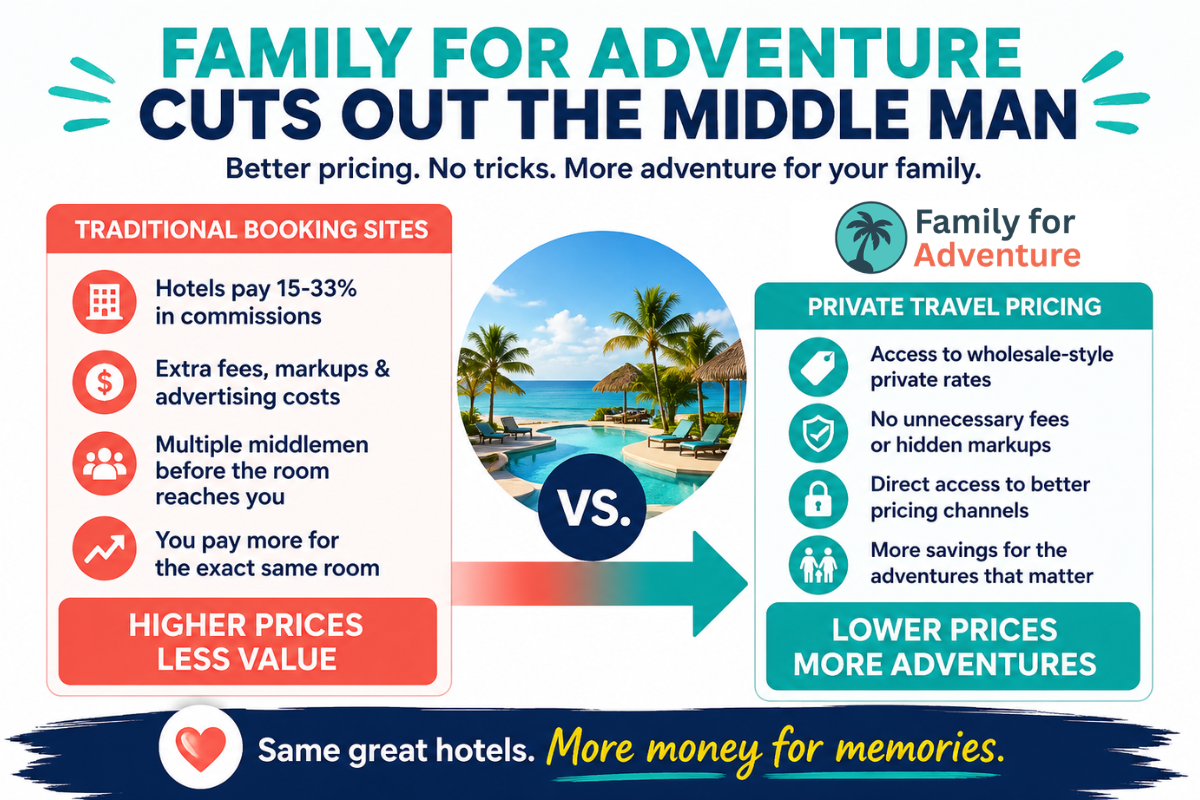
The reason many families overpay for hotels and resorts is not because they picked the wrong website. It is because most public booking sites are built on the same commission-based pricing system.
When you search on major online travel agencies, the price you see usually includes room for commissions, platform markups, advertising costs, and the layers of middlemen involved in getting that room in front of you. Even when the sites look different, many of them are pulling from the same public pricing structure. Family for Adventure gives families a different way to book.
Instead of only showing the same public rates found across the big online travel agencies, Family for Adventure gives members access to private travel pricing through a wholesale-style booking platform. This helps remove unnecessary layers of markup and gives families access to rates that are not built for the public OTA model. That is where the savings come from.
You are not using points. You are not waiting for a last-minute flash sale. You are not playing games with confusing reward programs. You are simply getting access to a better pricing channel for hotels, resorts, and travel accommodations.
You get access to deals not available on public OTAs
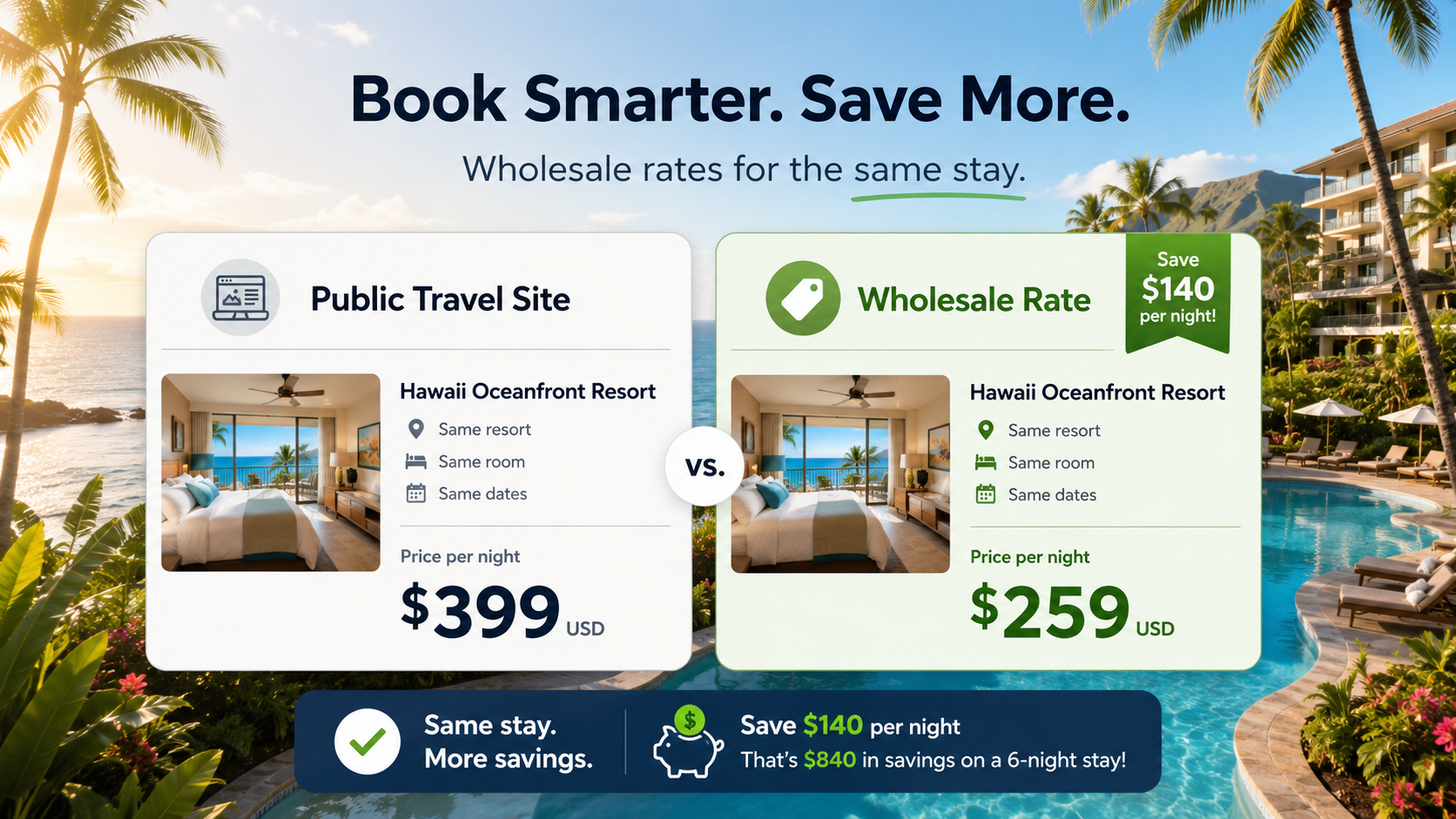
Most travelers assume the big booking sites show all the best available prices. That is exactly what those sites want you to believe. But the truth is, public OTAs only show public OTA pricing. Hotels and resorts often have different pricing channels for different types of buyers. Public travelers see one price. Travel agents, wholesale partners, private groups, and member-based platforms can access a different level of pricing.
Family for Adventure helps families tap into that private side of travel. That means you can search for the same destination, the same travel dates, and sometimes even the same hotel or resort — and see pricing that is not available on public booking sites like Expedia, Orbitz, Priceline, or Travelocity. For a family, that difference matters.
A lower hotel rate can turn into an extra night away. A better resort can fit inside the same budget. The money saved on the room can go toward activities, meals, excursions, or experiences your kids will actually remember. That is the real value. It is not just about finding a cheaper hotel. It is about making the whole trip more possible.
How Family for Adventure helps your family travel more

The biggest problem families face with travel is not a lack of desire. Most families want to travel more. The problem is the cost. By the time you add up the hotel, flights, rental car, food, activities, resort fees, and everything else, a trip that started as a simple idea can quickly feel out of reach. That is why so many families keep putting off the vacations they actually want to take.
Family for Adventure helps solve that problem by giving families a smarter way to book. When you can save on one of the biggest parts of the trip — the hotel or resort — you create more room in the budget for everything else. Instead of cutting the trip short, settling for a lower-quality stay, or skipping the fun extras, you can make your travel dollars go further.
That can mean more trips throughout the year. It can mean better destinations. It can mean nicer resorts, longer stays, or simply less stress when planning the vacation. And that is the whole point. Family for Adventure exists to help families stop overpaying through public booking sites and start using a smarter travel system. Because when travel costs less, families can say yes to more memories, more experiences, and more adventures together. 👉 Try it for yourself and see how much you could save.
Why Booking Direct Does Not Always Save You More
Booking direct can be useful, but it is not always cheaper

Hotels love to tell you that booking direct saves money, but the reality is more complex. While some properties offer perks like free breakfast, room upgrades, or loyalty points when you book through their website, these benefits don't always translate to actual savings. Many hotels participate in rate parity agreements that prevent them from undercutting their distribution partners significantly.
The "book direct and save" messaging became popular as hotels tried to reduce their dependence on OTA commissions. However, smart travelers know that price differences between booking direct vs OTA platforms are often minimal or nonexistent. Sometimes OTAs even offer better deals through flash sales or package bundles that hotels can't match on their own sites.
Direct booking does have advantages beyond price - better customer service, easier cancellations, and room preference requests. But if you're purely focused on getting the lowest rate, assuming the hotel's website will always win is a mistake that could cost you money.
Price parity can keep public prices similar

Price parity agreements create an artificial price ceiling across booking platforms. These contracts require hotels to offer the same rates on their direct booking sites as they provide to Expedia hotel deals and other major OTAs. The goal is preventing a race to the bottom where different sites constantly undercut each other.
This system explains why you'll often see identical room rates across multiple travel booking sites. Hotels can't offer significantly lower prices on their own websites without violating their agreements with OTA partners. While they might throw in extra amenities or services, the base room rate stays consistent.
The Expedia pricing strategy and similar approaches from other major players rely on these agreements to maintain their commission-based business model. Without price parity, travelers would simply find the cheapest option and booking sites would lose their value proposition.
The better move is to compare direct, OTA, and private pricing
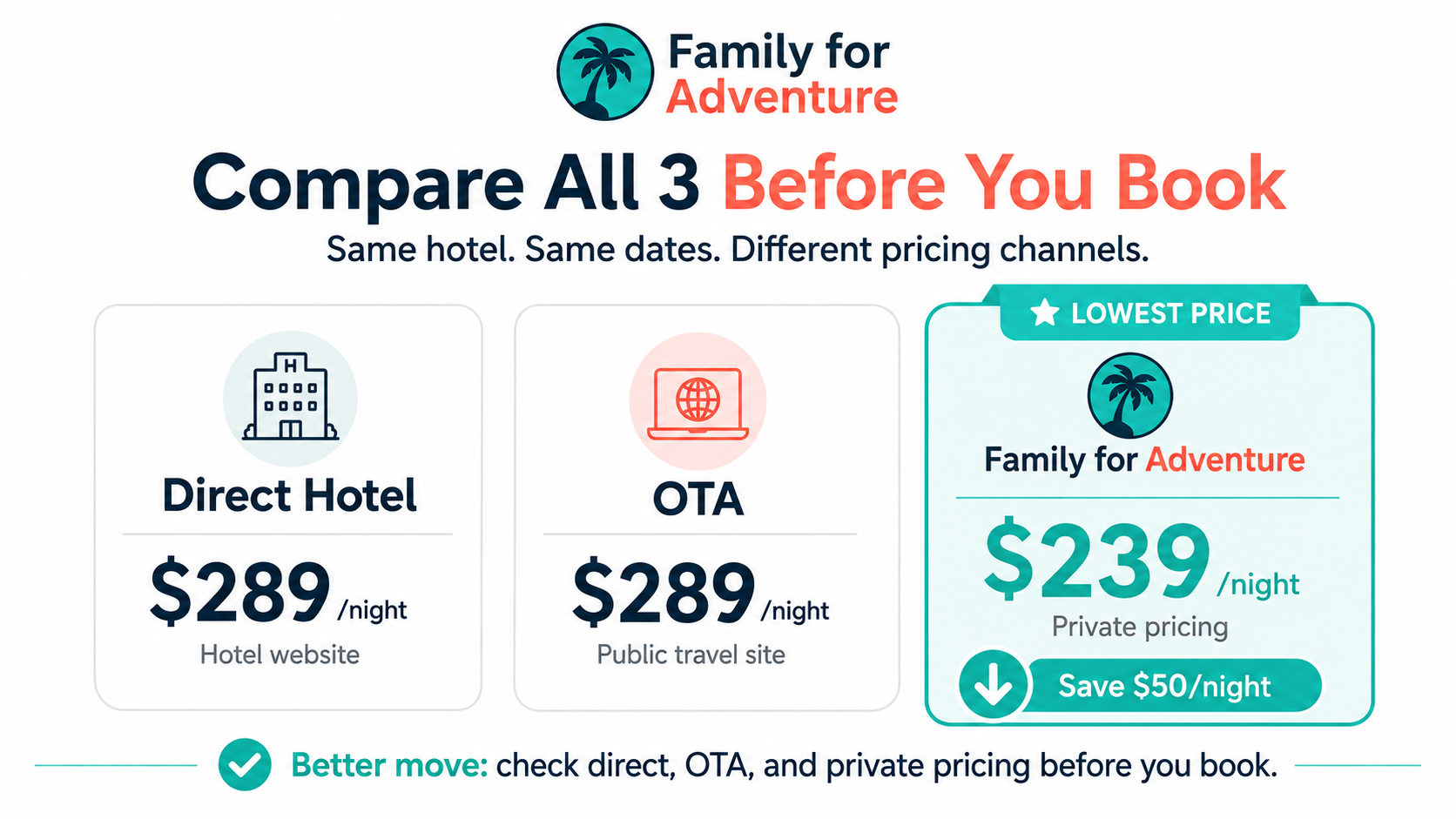
Smart vacation booking tips always include checking multiple sources before committing to any reservation. Start with the hotel's direct website to see their rate and any included perks. Then check major OTAs for the same dates - sometimes they offer package deals or promotional rates that beat the direct price.
The real opportunity lies in wholesale travel booking platforms that operate outside traditional price parity agreements. These sites often have access to contracted rates that aren't available to the general public. Family for adventure and similar wholesale platforms can offer genuine savings because they work with different inventory and pricing structures.
Don't forget to factor in the total cost, not just the room rate. A slightly higher direct booking price might include benefits like free parking or breakfast that would cost extra elsewhere. Calculate the true cost difference before making your final decision. The travel commission structure means different booking methods have different overhead costs, which can sometimes work in your favor.
Cancun Savings Spotlight
Ocean View / 2 Queen Room / 6 Nights
Public OTA Price: $2,934 | Family for Adventure Price: $2,292
Total Savings : $
Why Credit Card Points May Not Save as Much as You Think
Points can be valuable, but they are not free

Credit card travel points often feel like magic money - you swipe your card, rack up points, and suddenly that vacation seems cheaper. The reality is more complex. Every point you earn represents actual spending on your credit card. To accumulate enough points for a meaningful travel redemption, you typically need to spend thousands of dollars through your card first.
Most travel credit cards require 50,000 to 100,000 points for a decent hotel stay or flight. Earning rates usually hover around 1-2 points per dollar spent on regular purchases. This means you're looking at $25,000 to $100,000 in spending to earn a "free" vacation that might be worth $500 to $1,500 in cash value.
When comparing vacation booking tips across different platforms, factor in the actual cost basis of your points. If you spent $50,000 to earn enough points for a $1,000 vacation, those points aren't really free - they cost you the opportunity to use that cash elsewhere or invest it differently.
Points can distract from the actual cash price

The psychology of points creates a dangerous blind spot in travel planning. When you see a hotel room priced at 40,000 points, your brain doesn't automatically translate that to its cash equivalent. This mental disconnect often leads to poor financial decisions when booking travel.
Many travelers become so focused on "maximizing point value" that they lose sight of whether they're actually getting a good deal. A hotel that costs 60,000 points might seem like a bargain compared to one that costs 80,000 points, even if both properties would be overpriced when paid in cash.
OTA pricing becomes clearer when you strip away the points confusion and look at actual dollar amounts. That same hotel room might be available for $200 per night on Expedia or other travel booking sites, while your points redemption represents a value of $300 worth of spending. The cash option suddenly looks more attractive.
Travel booking sites like wholesale platforms can offer straightforward cash pricing without the mental gymnastics required to calculate point values and redemption rates.
Credit card debt in America is a major problem
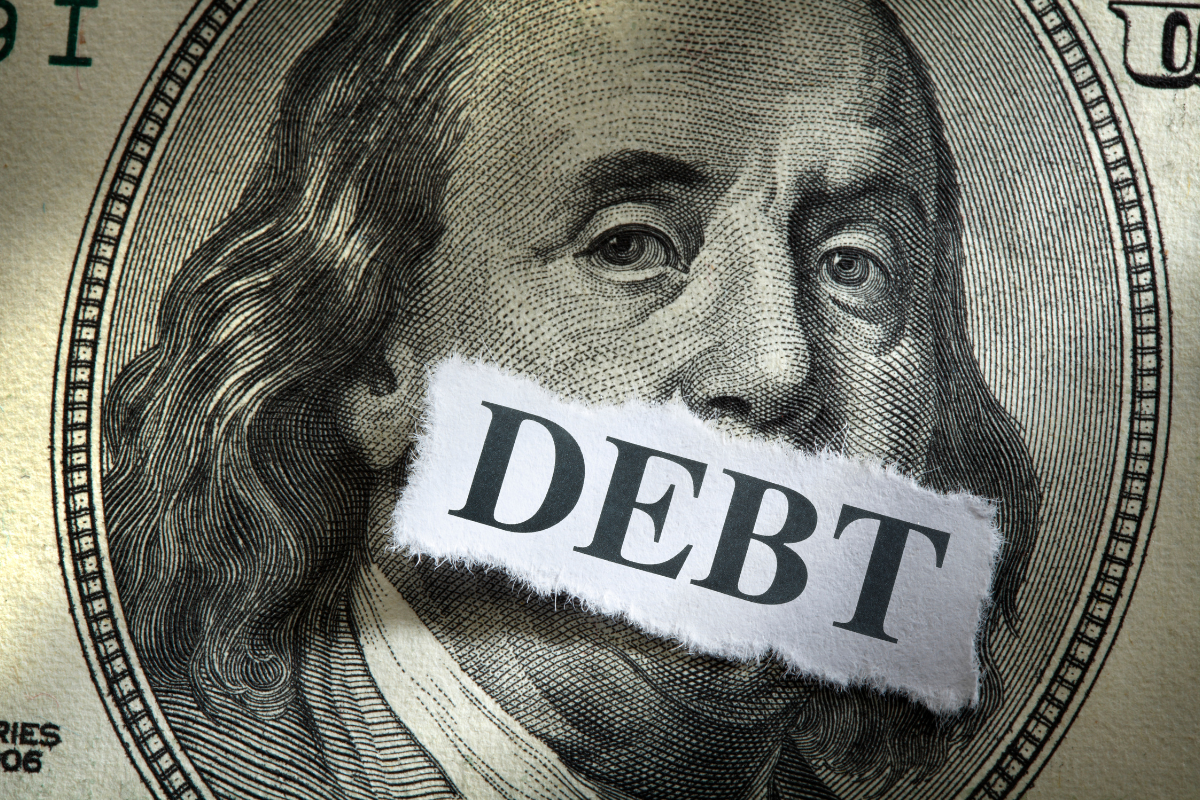
The pursuit of credit card travel points contributes to a broader financial crisis affecting millions of Americans. Federal Reserve data shows that credit card debt has reached record highs, with the average household carrying over $6,000 in revolving credit card balances.
Travel enthusiasts often justify additional spending by pointing to the points they'll earn, creating a dangerous cycle where vacation dreams fuel debt accumulation. The high interest rates on credit cards - often 20% or higher - quickly erode any value gained from point earnings.
Consider this scenario: you spend an extra $5,000 on your credit card to reach a signup bonus for 60,000 points worth approximately $600 in travel value. If you can't pay off that $5,000 immediately and it carries a 22% interest rate, you'll pay more than $1,100 in interest charges over a year. Your "free" vacation just cost you $500 in interest alone.
The Smarter Way to Book Your Next Trip
The travel booking world is more complicated than most people realize. The big online travel sites make it feel like you are comparing all your options, but in many cases, you are only comparing different versions of the same public pricing system. That is why booking smarter matters.
Expedia, Orbitz, Priceline, Travelocity, and other major OTAs can be useful tools, but they are not always built to show you the lowest available travel price. Direct booking does not automatically mean you are getting a better deal either. And while credit card points can have value, they often come with restrictions, limited availability, annual fees, blackout dates, or complicated redemption rules that make the savings less powerful than they seem. The better approach is to stop booking based on habit and start booking based on access.
If you only search public travel sites, you are only seeing public travel prices. But when you understand how hotel pricing really works, you can start looking for better booking channels — the kind that give you access to private rates, wholesale-style pricing, and deals that are not shown on the big public OTAs. That is exactly where Family for Adventure fits in.
We help families find a smarter way to book hotels, resorts, and travel accommodations by giving them access to private travel pricing designed to help their vacation budget go further. Instead of overpaying through the same public booking sites, families can compare better options, save money on one of the biggest parts of the trip, and use those savings for the experiences that make the vacation worth remembering.
Because the goal is not just to book a cheaper room. The goal is to make travel feel possible again — more trips, better stays, longer vacations, and more memories with the people who matter most. When you are ready to plan your next trip, try Family for Adventure here and see how much further your travel budget can go.